
Home sleep test or polysomnography: understanding your sleep study
A sleep study helps detect sleep apnea and describe its characteristics. A home respiratory polygraphy and a polysomnography do not provide the same information. Understanding their differences and the technologies used helps you read your result and plan the next steps with your doctor.
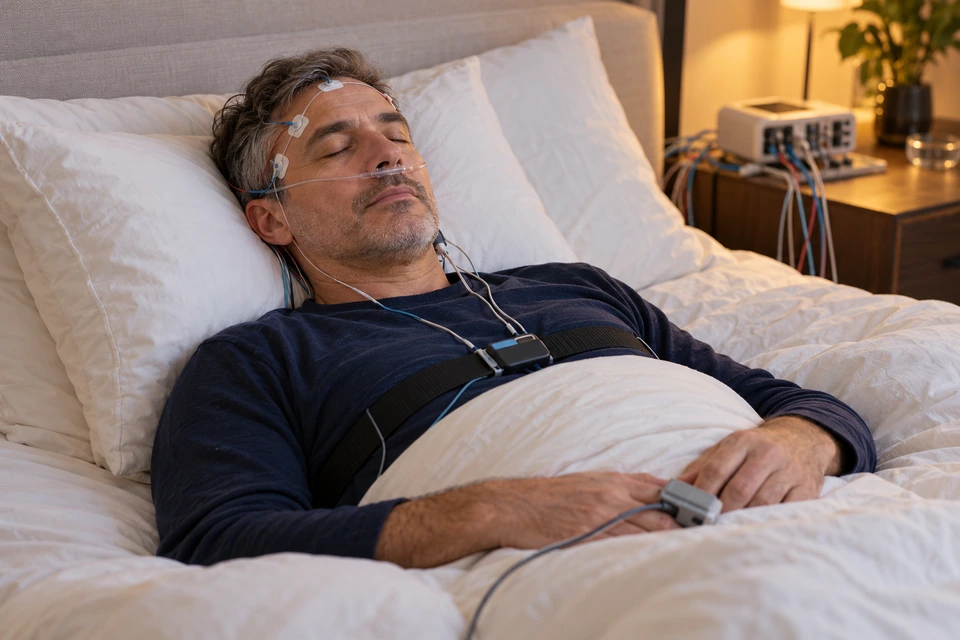
Home respiratory polygraphy: studying breathing during the night
Home breathing tests can use different technologies. A conventional respiratory polygraphy mainly records airflow, breathing effort and oxygen saturation. It also records pulse and, depending on the device, body position and snoring.
Conventional polygraphy does not usually record brain activity. It therefore does not directly determine sleep stages or brain micro-arousals. If a person stays awake for a long time, using the monitoring time rather than the time actually asleep may underestimate how often events occur.
Some home tests, such as WatchPAT, use peripheral arterial tonometry (PAT): a finger sensor records a vascular signal, which is analysed together with oxygen levels, pulse and other signals, including movement. Their algorithms estimate breathing events as well as sleep time and certain sleep stages. These estimates are not based on brain recording by EEG, unlike polysomnography. 3
These home tests may be suitable for adults with suspected obstructive sleep apnea who do not have a complex medical situation calling for a more complete study from the outset. The doctor chooses the method according to your situation and interprets the result together with your symptoms.
Polysomnography: also analysing sleep itself
Polysomnography combines breathing measurements with brain activity (EEG), eye movements and muscle activity. Other signals complete the analysis depending on the clinical question.
It measures sleep time, sleep stages and micro-arousals, and relates breathing events to this information. It can also help investigate other conditions, for example certain unusual movements or behaviours during the night.
It is often performed in a laboratory with technical supervision — a type 1 study. A full polysomnography can also be performed at home in some settings — type 2. The location alone therefore does not define the level of investigation.
The key differences in one table
| Polygraphy and home breathing tests | Polysomnography | |
|---|---|---|
| Main signals | Breathing and oxygen levels; some devices, such as WatchPAT, use a vascular signal from the finger | Breathing signals plus brain, eye and muscle recording |
| Sleep time and stages | Not directly measured by conventional polygraphy; estimated by algorithms with PAT devices | Determined from sleep signals |
| Brain micro-arousals | No EEG measurement with these devices | Identifiable by EEG |
| Usual setting | At home | Laboratory, sometimes at home for a full recording |
| Point to note | Methods and limits vary by device; possible underestimation with conventional polygraphy if wakefulness is prolonged | More complete study, more organisation and more sensors |
When is polysomnography preferred?
The doctor takes into account, in particular:
- Significant heart or lung disease, suspected hypoventilation or central sleep apnea.
- Certain neuromuscular diseases, long-term opioid use or other complex medical situations.
- Significant insomnia or a suspected sleep disorder that a simplified breathing test does not explore.
- A home test that is negative, inadequate or inconsistent with a persistent clinical suspicion.
These examples guide the choice; they are not a questionnaire for prescribing yourself a test. A properly indicated home test can be entirely appropriate. Polysomnography provides further investigation when needed. 1 2
How to understand the figures in your report
The apnea-hypopnea index (AHI) expresses the number of events per hour of sleep. Without a measurement of sleep, a respiratory index may be calculated over the monitoring time; a PAT device uses an estimated sleep time.
The doctor also looks at oxygen levels, technical quality, symptoms, medical history and, where available, position and REM sleep. Indices from different methods are not always directly interchangeable.
A “normal” result therefore does not automatically rule out sleep apnea if symptoms remain suggestive. After a negative, inconclusive or technically inadequate home test, the AASM recommends polysomnography to continue the diagnosis. The 2025 VA/DoD guideline also allows a repeat home recording to be discussed in some situations. The doctor chooses the next step according to your clinical context. 1 4
At Shalvina: turning the result into clear next steps
Bring the full report of your sleep study, even if it was done elsewhere. Dr Marc Boukhris combines its analysis with a complete ENT examination, then explains the conclusions and options with a written report and a personalised plan.
Tests continue to be organised through your usual care pathway. When an oral appliance is chosen, a check with the appliance in place then assesses its effectiveness.
Have you had a sleep study and want to understand what comes next?
Scientific references
-
Department of Veterans Affairs / Department of Defense. Clinical Practice Guideline for the Management of Chronic Insomnia Disorder and Obstructive Sleep Apnea. Version 3.0, 2025. Full professional guideline.
-
Ellender CM, Ruehland WR, Duce B, et al. Australasian Sleep Association 2024 guidelines for sleep studies in adults. Sleep. 2024;47(10):zsae107. doi:10.1093/sleep/zsae107. ASA professional guidelines.
-
Pinilla L, Chai-Coetzer CL, Eckert DJ. Diagnostic Modalities in Sleep Disordered Breathing: Current and Emerging Technology and Its Potential to Transform Diagnostics. Respirology. 2025;30(4):286–302. doi:10.1111/resp.70012. Specialist review, including PAT devices.
- Kapur VK, Auckley DH, Chowdhuri S, et al. Clinical Practice Guideline for Diagnostic Testing for Adult Obstructive Sleep Apnea: An American Academy of Sleep Medicine Clinical Practice Guideline. Journal of Clinical Sleep Medicine. 2017;13(3):479–504. doi:10.5664/jcsm.6506. Official AASM guideline, including after a negative or inconclusive home test. Founding reference, read alongside the 2025 VA/DoD guideline.