
Sleep apnea appliance and night guard for bruxism: what is the difference?
A night guard for bruxism and a mandibular advancement device can both be worn at night, but they do not have the same purpose. The first mainly aims to protect the teeth; the second moves the lower jaw forward to treat obstructive sleep apnea in patients for whom it is indicated.1
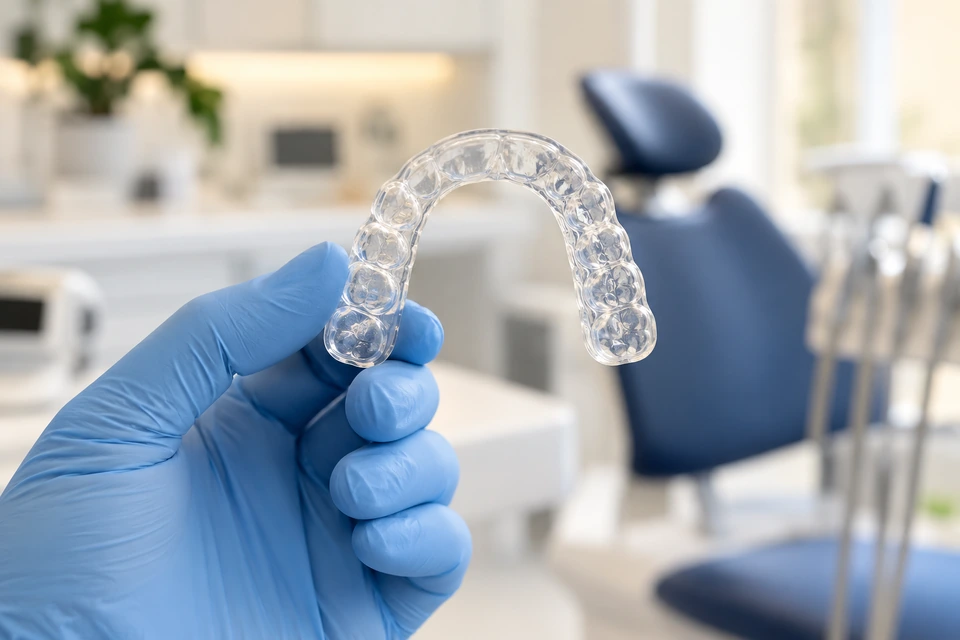
What is a night guard for bruxism for?
Bruxism is activity of the jaw muscles, which may show up as clenching or grinding of the teeth. It can occur during sleep or while awake.2
Depending on the dental assessment, a night guard may be suggested to protect the teeth and restorations from some of the consequences of this activity. Wearing one does not mean the bruxism goes away.3
A conventional protective night guard is not designed to hold the jaw forward to treat sleep apnea.
What does a mandibular advancement device do?
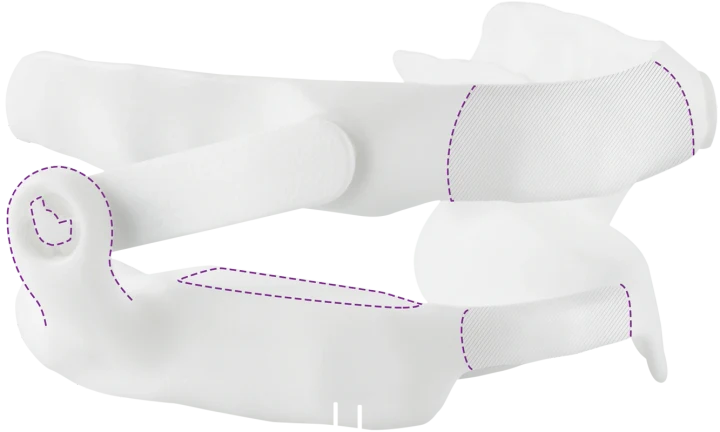
A mandibular advancement device (MAD) holds the lower jaw forward during sleep. In this way, it aims to reduce obstruction of the airway.
The indication takes into account the medical assessment and whether the appliance can be worn from a dental point of view. A custom adjustable appliance allows this position to be adapted gradually. Follow-up covers comfort, dental health and the treatment result.1
For sleep apnea, effectiveness is checked by a sleep test with the appliance in place: less snoring is not enough to confirm that breathing events are controlled.
The differences at a glance
| Conventional night guard | Mandibular advancement device | |
|---|---|---|
| Main goal | Protect the teeth according to identified needs | Treat obstructive sleep apnea when indicated |
| Intended action | Place a protective layer between the teeth | Hold the lower jaw forward during sleep |
| Assessment | Dental assessment and consequences of bruxism | Medical assessment of sleep apnea and dental evaluation |
| Follow-up | Dental health, appliance and any symptoms | Tolerance, adjustments, dental health and sleep testing |
Can you have both bruxism and sleep apnea?
Yes. However, having both does not mean that a single appliance will automatically address both conditions.
The choice takes into account your sleep, your teeth, your restorations and how your jaw functions. The aim is to build a consistent strategy, without assuming that a protective night guard treats sleep apnea or that a MAD will necessarily stop bruxism.1,3
I already have a night guard: what should I do?
If you snore, if others notice breathing pauses or if you feel unusually sleepy, talk to your doctor. Wearing a night guard can neither establish nor rule out sleep apnea.
For an assessment, bring your current appliance, your sleep tests and any previous dental assessments or panoramic X-rays, if you have them. This allows what has already been done to be taken into account.
If your doctor has already referred you for a MAD, you can book directly with Dr Chira Riahi-Boukhris in Netanya, bringing the recommendation with you.
At Shalvina, the choice of appliance is part of personalised sleep care. Learn about the dental assessment, Panthera appliances and the support we provide.
Scientific references
-
Levine M, Cantwell M, Postol K, Schwartz D. Dental Sleep Medicine Standards for Screening, Treatment, and Management of Sleep-Related Breathing Disorders in Adults Using Oral Appliance Therapy: An Update. Journal of Dental Sleep Medicine. 2025;12(2). doi: 10.15331/jdsm.7384. View the AADSM professional standards.
-
Verhoeff MC, Lobbezoo F, Ahlberg J, et al. Updating the Bruxism Definitions: Report of an International Consensus Meeting. Journal of Oral Rehabilitation. 2025;52(9):1335–1342. doi: 10.1111/joor.13985. View the reference.
-
Balasubramaniam R, Manfredini D, Guan G. Sleep Bruxism: A Narrative Review of Current Concepts, Mechanisms, and Clinical Implications. Journal of the Royal Society of New Zealand. 2026;56(2):e70046. doi: 10.1002/snz2.70046. View the review.