
Drug-induced sleep endoscopy (DISE): what is this test for?
Knowing that sleep apnea is present does not always show where or how the throat closes during sleep. Drug-induced sleep endoscopy, known as DISE, provides a dynamic view of the airway under monitored sedation. In some patients, it helps clarify the mechanisms of obstruction to better guide treatment.12
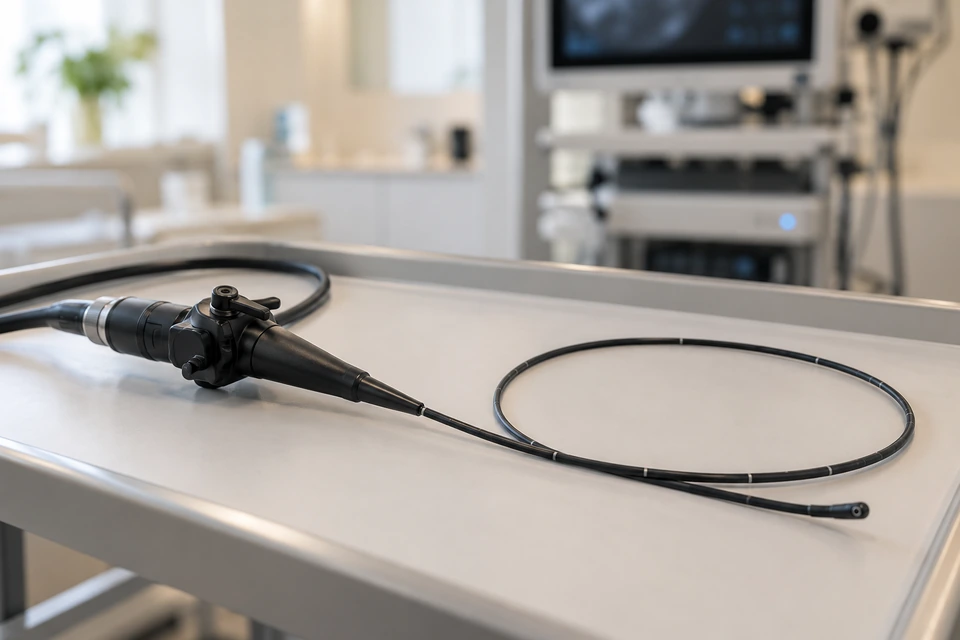
What can be seen during DISE?
The test allows the soft palate, the walls of the pharynx, the base of the tongue and the epiglottis to be observed. The practitioner describes the areas involved, how much they close and the pattern of closure: front to back, side to side or concentric.
This analysis can be structured using the VOTE classification, which organises the observation of these four regions. The aim is to go beyond an anatomical description at rest and understand how these structures behave under sedation.2
Which patients may benefit from this test?
DISE may be discussed in particular:
- When CPAP is refused, poorly tolerated or insufficient, if the test may help choose another strategy.
- Before certain surgical treatments, to clarify the sites and mechanisms to address.
- When several levels of obstruction appear to be involved.
- When symptoms persist or recur after treatment, particularly surgery.
- In certain situations where uncertainty about the mechanism of obstruction could influence the choice of an oral appliance.1,2
It is not a routine test for every case of sleep apnea: its relevance depends on the question it could answer.
How is drug-induced sleep endoscopy performed?
The test is carried out in a suitable setting, in an operating room or a dedicated room, with anaesthetic monitoring. Sedation is given, then a flexible endoscope is passed through the nose to observe the throat.
Dr Marc Boukhris’s information sheet indicates that the test itself usually takes 15 to 30 minutes. Additional time is needed for preparation and recovery; the team will tell you the total time on site.
How is it different from polygraphy or polysomnography?
Sleep studies examine breathing events, oxygen levels and, depending on the technique, sleep itself. They are used to diagnose and assess sleep apnea.
DISE mainly observes where and how the airway closes. It does not measure your whole night and replaces neither a polygraphy or polysomnography nor the ENT examination performed while awake. This information is complementary.2,3
How can the results guide treatment?
The observations are considered together with your symptoms, the ENT examination and your sleep study results. They can help choose a targeted surgical procedure, a strategy addressing several levels of obstruction or certain non-surgical options.
The test can also help rule out a procedure that does not seem suited to the mechanism observed. It contributes to a personalised decision; it does not mean that an operation will be needed.1,2
Is DISE required before an oral appliance?
No. It can be useful in selected cases, but it is not a mandatory step before every mandibular advancement device.
If your doctor already recommends this treatment, the dental assessment can be arranged directly. DISE is added only if its clinical value for your situation is established.
How to prepare for the test and plan your return home
The team will give you instructions on fasting, your usual medication and being accompanied, adapted to your situation. Bring your sleep reports and tell the team about your medications, allergies and medical history. Do not change your treatments on your own.
After sedation, a period of monitoring is required. Discharge, going home with a companion and any restrictions on driving or activities follow the team’s instructions. The expected benefits, precautions and risks of sedation and of the endoscope are explained before the test.
Can the success of a treatment be predicted with certainty?
DISE provides useful information, but sedation does not fully reproduce natural sleep. Its value also depends on how it is performed and interpreted.
Recent publications support targeted use while noting that it does not guarantee the success of surgery or an oral appliance. The effectiveness of the chosen treatment must then be checked.3
At Shalvina: understanding before choosing
During the consultation, Dr Marc Boukhris performs a complete ENT examination and reviews the available tests. If DISE could provide useful information, he explains why, what is expected from it and how the results could change the options being considered.
The aim is to give you explained conclusions, a written report and a plan for the next steps, taking your whole assessment into account.
Dr Marc Boukhris’s DISE information sheet (Hebrew)
Would you like to know whether further investigation would be useful for your sleep apnea?
Scientific references
-
Olszewska E, De Vito A, Baptista P, et al. Consensus Statements Among European Sleep Surgery Experts on Tongue, Hypopharynx, and Supraglottis Associated with Snoring and Obstructive Sleep Apnea: Part 1: Evaluation and Decision Making. Journal of Clinical Medicine. 2026;15(1):80. Published online 22 December 2025. doi:10.3390/jcm15010080. European consensus.
-
Triantafillou V, Dedhia RC, Rodin JG. Current Techniques and Role of Drug Induced Sleep Endoscopy for Obstructive Sleep Apnea. Current Otorhinolaryngology Reports. 2025;13:15. doi:10.1007/s40136-025-00529-5. Specialist review.
-
Labra A, Roldán-Navarro M, Díaz-Inzunza N, Ruiz-Morales M. DISE in OSA: valuable tool or an overestimated technique? A systematized review. Sleep and Breathing. 2026;30:222. doi:10.1007/s11325-026-03769-x. Structured review.